Foley 101 · Part 3 of 3
How Is Foley Recorded?
The workflow behind a Foley session, step by step, from the first viewing to the tracks that reach the mix.
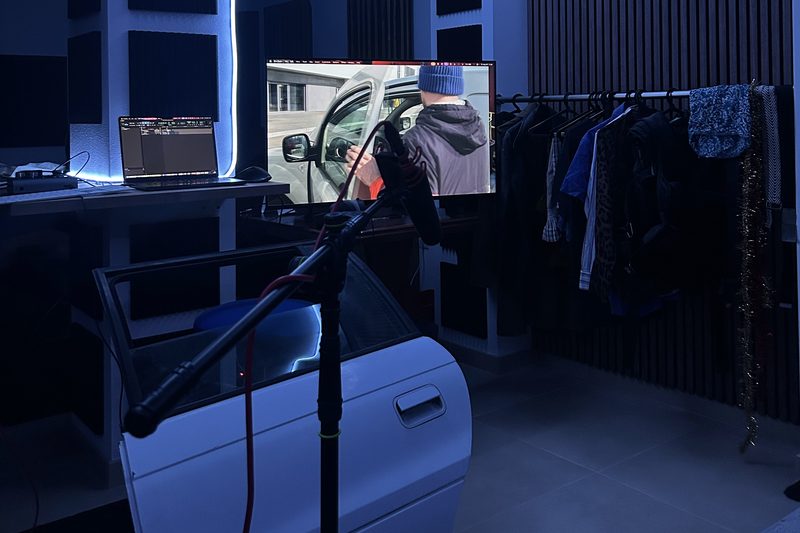
From the outside, a Foley session can look simple: someone walking on the spot in front of a screen. Behind it there’s a fairly precise workflow. Every studio has its own habits, but the steps are broadly the same. Here’s how it usually goes.
Step 1Watching the scene
Everything starts with the picture. The first viewing is for the story: who these people are, and what the scene needs to feel like. The second is practical: where are the feet visible, what do the hands touch, what happens off-screen that should still be heard?
It’s worth listening to the production sound as well. Sometimes a footstep recorded on set is fine and only needs a little support. Sometimes nothing usable survived.
Step 2Spotting what needs Foley
Spotting means going through the film and listing what needs recording: who walks, on what, in which shoes, and what they touch along the way.
On bigger projects this becomes a cue sheet shared by the team. On smaller ones it can be a simple list per reel or episode. Either way, it saves a lot of time once you’re on the stage.
Step 3Choosing shoes, props and surfaces
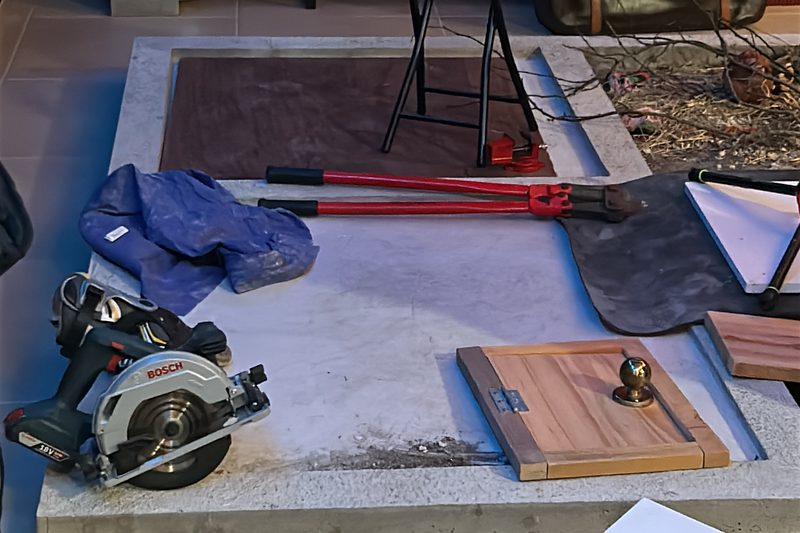
Next, the materials. The aim is to match the sound the scene needs, which isn’t always the object you see on screen. Sometimes a different shoe, or a different floor, sounds more like the one in the shot.
Many stages have surfaces built into the floor, such as concrete, wood, earth or gravel. Others get put together on the day. A quick test with the microphone on usually settles it faster than guessing.
Step 4Microphone and recording setup
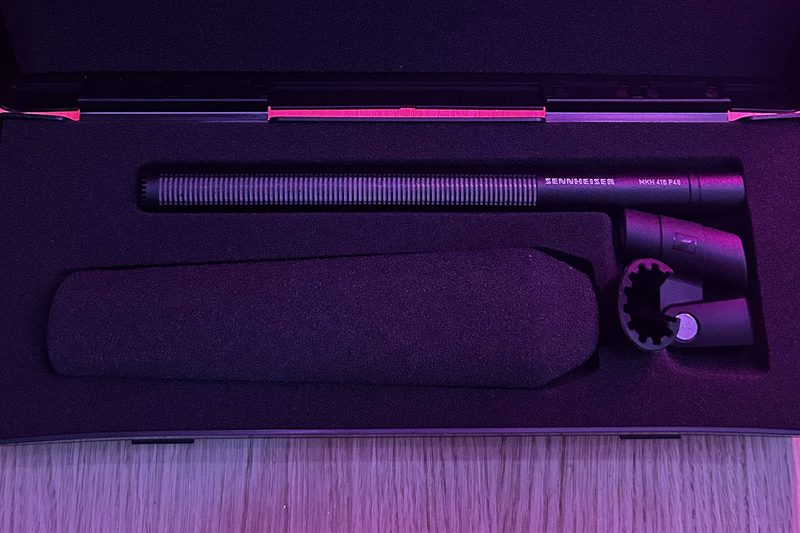
Foley is usually recorded close and fairly dry, in an acoustically treated room, so the sound can be placed anywhere later in the mix. A common setup is one main microphone, often a short shotgun or a hypercardioid, aimed at the action from slightly above, sometimes with a second mic further back to give a more distant option.
On bigger stages, the recording is run by a Foley mixer while the artist performs. I normally work alone, so the spotting, recording and editing are all mine. I use a Sennheiser MKH 416, and there’s no fixed distance: it depends on the sound I’m recording.
Sessions for film and television are usually recorded at 48 kHz and 24-bit, the standard for picture delivery, although some studios record at higher sample rates.
A quiet room, and quiet clothes
With the microphone close and the gain up, everything is audible: a fridge in the next room, traffic outside, the performer’s own clothes. Foley artists tend to wear soft, quiet clothing and take off anything that jingles, unless of course the scene needs it.
Perspective and distance
Microphone distance is a creative choice. A close-up of feet wants a close, detailed step. A wide shot of someone crossing a car park wants something further away and softer. Getting perspective roughly right at the recording stage makes the mix far easier than trying to fake distance afterwards.
Step 5Performing in sync
With the scene playing, usually with a short pre-roll to find the rhythm, the artist performs along with the picture. The timing has to be close. At 25 frames per second a frame lasts 40 milliseconds, and a footstep two frames late can already feel off.
Timing is only half of it. The other half is how the person moves: how hard, how fast, how carefully. It’s easy to overdo, because most real movement is quieter than you’d think. And a character has to sound like the same person all the way through, even when their scenes are recorded days apart.
Step 6Recording multiple takes
One take is rarely enough. There are usually a few passes per cue, keeping the best and sometimes combining parts of different takes. A softer and a firmer version of the same moment also gives the editor and the mixer options later.
A note on passes
Foley is normally recorded in separate passes rather than everything at once: footsteps for each character, then cloth, then props. Each layer stays clean, and each can be balanced on its own in the mix.
Step 7Editing and cleanup
Then the edit. Takes are chosen and lined up with the picture, and anything that shouldn’t be there is removed: clicks, breaths, a creak in the floor, the rustle of the performer’s own clothes. Footsteps in particular are often nudged one by one until each lands on the right frame.
Sync is judged by eye and ear together. The right place for a sound is where the contact looks and feels right, which isn’t always the exact frame where a foot touches the ground.
Step 8Delivering the Foley
Finally, the Foley is handed over for the final mix, where it’s balanced against dialogue, music and effects. It’s delivered as organised tracks, usually split by type (feet for each character, cloth, props) and clearly named, so anyone opening the session can find their way around.
The same tracks also feed the M&E mix for international versions, which is one more reason to keep them complete and tidy.
That closes Foley 101. Next in the Journal: a closer look at the craft itself, starting with footsteps.